Not a Ritual. A Protocol. What “Zen Calligraphy” Actually Means Here
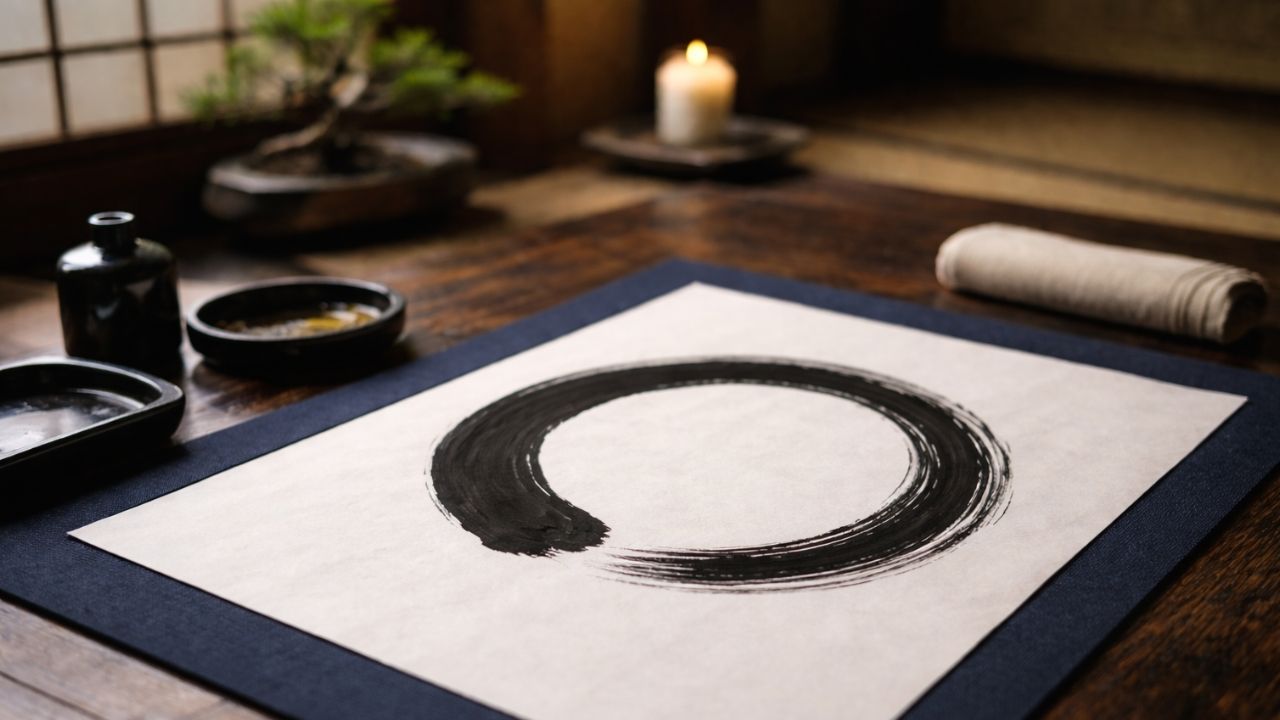
First, a Clear Statement
Zen calligraphy in this space is not a religious ritual.
It is training.
No vows, no conversion, no doctrine—just a practice architecture designed to cultivate attention, clarity, and inner stability.
Why the Confusion Happens
In English, “Zen” often arrives as a package label.
People associate it with Buddhism, temples, or spiritual identity.
That association is understandable, but it is not the operating meaning we use here.
Here, “Zen” names a training orientation: directness, standards, and returning.
What This Practice Does Not Ask From You
It does not ask what you believe.
It does not ask you to adopt a worldview.
It does not rank religions, replace them, or compete with them.
It does not use calligraphy as a disguised sermon.
The only thing it asks is whether you are willing to practice under clear constraints.
So What Is It, Exactly?
Think of it as a protocol—like strength training for attention.
The brushstroke is the unit of work, and repetition is the method.
Standards keep the session honest, because the page records what happened without interpretation.
In other words, the practice is measurable even when the inner change is subtle.
Why “Training” Matters More Than “Expression”
Many modern creative classes center expression and mood.
This one centers discipline and refinement.
That shift matters because expression can become endless self-negotiation.
Training reduces negotiation by giving you a stable task, clear edges, and a repeatable sequence.
For people with decision fatigue or a noisy mind, that structure is the point.
A Practice That Doesn’t Compete With Your Beliefs
Compatibility is built into the design.
A ritual binds you to meaning and belief; a protocol binds you to method and standards.
Here, the binding is procedural.
You can bring your faith, your skepticism, or your secularism—and still practice fully, because the practice is not asking to be worshipped.
What We Mean by “Zen” in Practical Terms
We mean fewer internal switches.
We mean less commentary while doing the work.
We mean the ability to return to basics without drama.
We mean refinement through repetition, not insight through explanation.
That is why we keep the environment quiet and the standards clear: not to create mystique, but to protect the signal.
If You’ve Avoided “Zen” Because of Religion
You’re not alone.
Many high-performing people avoid anything labeled “Zen” because it feels like a belief system in disguise.
This is precisely why we define it differently.
Here, “Zen” is not an identity. It’s an operating mode.
The Redefinition
This is not a ceremony.
It is a training system for quiet strength—built on standards, correction, and returning.
And because it is training, it can coexist with whatever you believe, without asking you to become something else.