Shodō as a Discipline: When Writing Becomes “Dō”
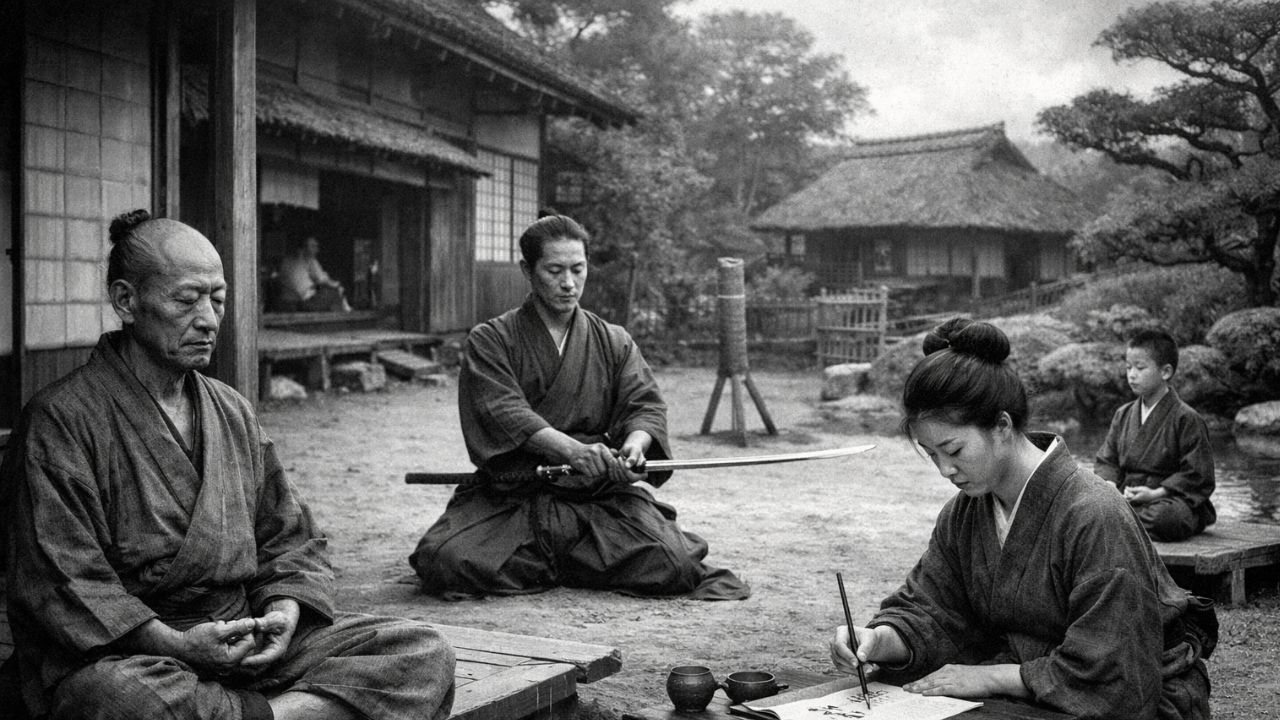
In modern life, “practice” is often confused with “more.”
More output. More content. More visible progress.
Shodō offers a different frame: practice as disciplined process, not production.
What “Dō” Actually Means Here
Shodō literally contains the character 道: “Dō,” often translated as “the way.”
In this context, “Dō” is not a slogan.
It is a structural claim: the practice trains the practitioner, not just the result.
The value is not limited to what appears on the paper.
The value is what the process does to attention, posture, breath, and decision-making.
Why This Matters: Not Another Consumption Category
Many modern arts are approached as leisure, expression, or lifestyle.
That approach is valid, and it can be genuinely meaningful.
But it creates a different contract with the practitioner.
The contract becomes: “I do this when I feel like it, and I stop when it becomes inconvenient.”
“Dō” is the opposite contract.
It is a practice designed to remain stable even when motivation is not.
An Official Educational Frame: More Than Skill Acquisition
Japan’s modern education system treated handwriting and shūji, another term for shodō (Japanese calligraphy) as a core competency in school life.
Within the teacher-facing guidance of arts education, the intent was framed beyond technique.
Not simply as acquiring knowledge or skill, but as training the person through the process.
This is not a modern reinterpretation.
It is an institutional statement about what practice is supposed to do.
The Phrase That Changes the Entire Meaning of Practice
One line from Ministry of Education-era teacher guidance is unusually direct.
“Training of the spirit is carried out in the process of practice.”
That single sentence removes the obsession with outcomes.
It defines training as what happens while repeating fundamentals.
Not after you become “good.”
Why Fundamentals Look Quiet (and Why That Is the Point)
If training happens in the process, fundamentals are not an entry stage.
Fundamentals are the stage.
Line quality, pressure control, and endings are not “boring basics.”
They are the most reliable environment for attention to become steady.
They are also where self-deception becomes visible, without needing dramatic content.
Posture and Breath Are Not Aesthetic Details
Teacher guidance for shūji explicitly treats posture and the conditions of writing as central.
Not as decoration, but as prerequisites for stable execution.
This is a practical claim.
When posture collapses, the line collapses.
When breath becomes shallow, tempo becomes unstable.
“Dō” insists that the body is part of the method.
“Mind and Technique as One” Is a Functional Standard
The idea of mind and technique aligning is often misunderstood as philosophy.
In practice, it is a quality-control standard.
When attention is clean, the stroke is clean.
When attention is noisy, the stroke reveals it immediately.
This is why shodō scales beyond the paper.
It trains the ability to keep execution stable under internal fluctuation.
Enjoyment Is Not Rejected—But It Is Not the Core Contract
Modern Japan also has strong “enjoyment” cultures around calligraphy and art.
There is nothing to deny there.
But this program is not built as entertainment or self-expression.
It is built as a repeatable inner training system.
It prioritizes discipline, refinement, and return.
Not intensity. Not performance. Not identity.
Closing: “Dō” Is a Design Choice You Can Adopt
Seeing shodō as “Dō” is not nostalgia.
It is a decision about what practice is for.
If training happens in the process, then your fundamentals are never “beneath” you.
They are where attention becomes durable.
And durability is the only kind of progress that transfers into life.