The Hard Part of “Simple”: Writing the Cross That Doesn’t Move
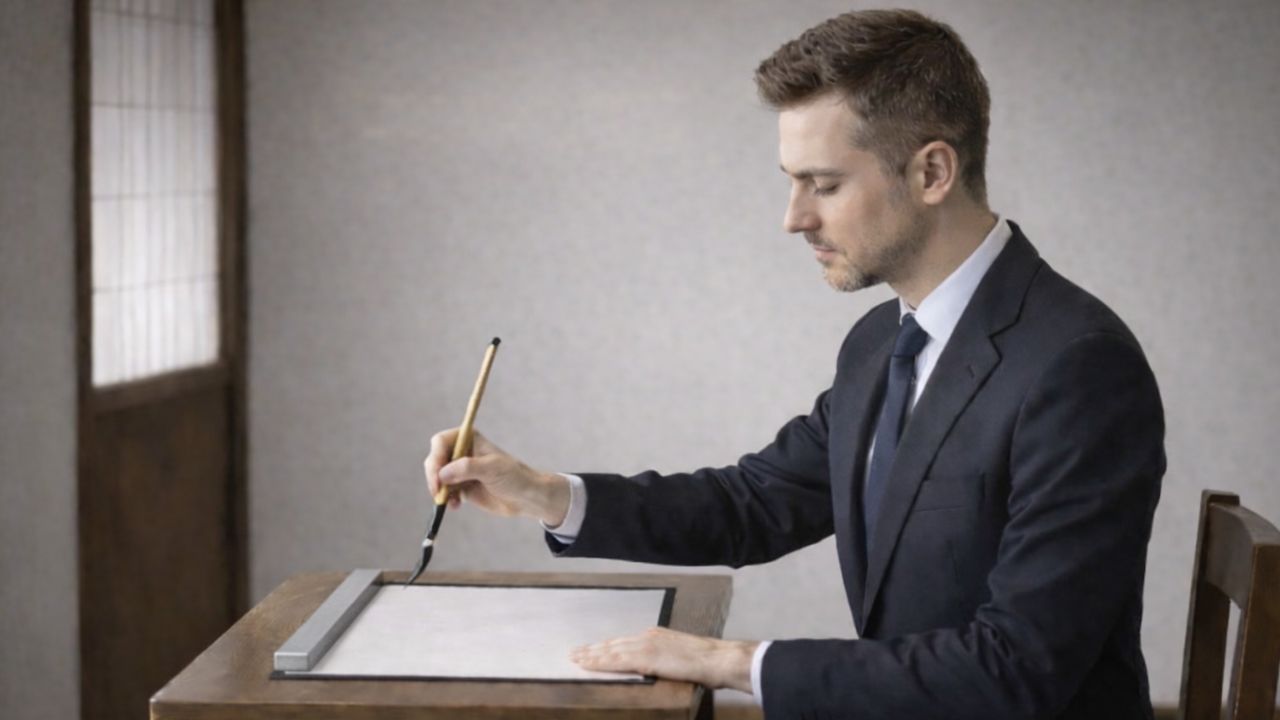
A good entrance course should feel accessible.
But “accessible” should not mean “thin.”
The entrance is where the standard is quietly set: not by difficulty, but by fidelity.
The course closes with a character that looks almost too simple: a cross of two strokes.
Two lines. No ornament. No place to hide.
What “Simple” Actually Tests
Simplicity is not the absence of skill.
It is the absence of distraction.
A complex form can mask unstable attention with complexity.
A cross cannot.
When the form is reduced, what remains is your control of pressure, speed, and intention.
Not as concepts.
As a visible record.
Two Lines, Many Variables
A stable vertical line is not one action.
It is a continuous negotiation: grip tension, shoulder position, breath timing, and contact with the page.
A stable horizontal line is not “just a second stroke.”
It is a second decision under the influence of the first.
Even a millimeter of drift reveals a pattern: impatience, over-correction, or the need to “finish.”
The cross is where these patterns become undeniable.
Why the Model Looks Easy
A reference sample often looks calm.
Not because the writer is talented.
Because the writer has removed excess movement.
The line quality you read as “natural” is usually trained subtraction.
Less force.
Less performance.
Less negotiation mid-stroke.
This is why copying the appearance rarely works.
The surface is not the skill.
The Entrance Course Is Not an Introduction
Most “beginner” experiences are designed to produce confidence fast.
This course is designed to produce accuracy early.
Accuracy does not flatter you.
It clarifies you.
When you try to write the cross with stable line quality, you quickly learn what you can and cannot control.
That information is the entrance.
Not the finished page.
Stability Is a Discipline of Attention
People often treat attention as a mood.
In practice, attention is a trained capacity.
The cross asks a narrow question: can you keep one decision intact for the full length of a stroke?
Can you keep the same standard from the first centimeter to the last?
If not, the issue is not your character.
It is your attention span under precision.
This is not motivational.
It is measurable.
What the Cross Exposes in You
Some people rush.
Some people hesitate.
Some people press too hard and then compensate.
Some people try to fix the line while the brush is still moving.
These are not “mistakes.”
They are signatures.
They reveal how you behave when the task is simple but the standard is exact.
That is why the entrance course ends here.
The cross is a mirror without drama.
Practice Without Goals, With Standards
This work is not about producing a perfect cross.
It is about returning to the same demand without negotiating it away.
The standard remains stable even when your performance is not.
That distinction is the core of practice without goals.
No chasing.
No self-talk.
Just repetition under a clean constraint.
A Minimal Protocol for the Final Character
Write fewer crosses, not more.
Quantity becomes noise when attention collapses.
Start with a single vertical line.
Stop before adding the horizontal.
Look at line quality only: pressure consistency, edge clarity, and the steadiness of the taper.
Then write the horizontal as a separate commitment.
Not as an afterthought.
End the session before you start forcing improvement.
The aim is not to win the page.
The aim is to keep the standard intact.
Returning Is the Entrance Skill
Most people think the entrance is about learning tools.
In this system, the entrance is learning return.
Return to posture.
Return to breath.
Return to line quality.
Return to the constraint.
A cross is two strokes.
Returning is the third stroke you cannot see.
And it decides whether practice becomes refinement or just repetition.
Closing: The Smallest Form Holds the Whole System
The cross at the end of the entrance course is not a trick.
It is a definition.
When the form is reduced, your mind becomes legible.
If two lines cannot stay stable, more complexity will not save you.
This is not discouraging.
It is clean.
The work starts where excuses end.
And that is why the entrance closes with something that looks simple.